 Javier Ruiz Jiménez
Effective Job Search using LinkedIn (I)
Reid Hoffman sent me an (automated) email on March 25, 2011, on behalf of LinkedIn, thanking me for having been among the first million LinkedIn members.
Actually, I was member number 304,005.
At that time LinkedIn was celebrating 100 million members; I believe it hit 500 million in 2018. I created my account on March 4, 2004.
From one member to 500 million in a few years, that reminds me that everything starts with one: one account, one word, one action, one line of code, just one!
A lot of time has passed since I started using LinkedIn, and it has grown into an extraordinary tool for professional relationships.
In my opinion, LinkedIn is now the number one option for professionals starting a job search. I say starting because finding a job requires more than a search and a LinkedIn profile.
I have been collecting best practices from recruiters and career consultants, and adding my own experience from having interviewed many candidates at my company over 16 years.
Friends and colleagues often ask me how to find a new job effectively or present themselves to potential employers. I am not an expert and mostly know only about IT jobs, but this post is a collection of my findings and the advice that I usually give them.
Even if you are not looking for a job now, remember that an effective job search starts a long time before it is needed.
This first article will explore the daily habits needed to find a better job.
Daily habits
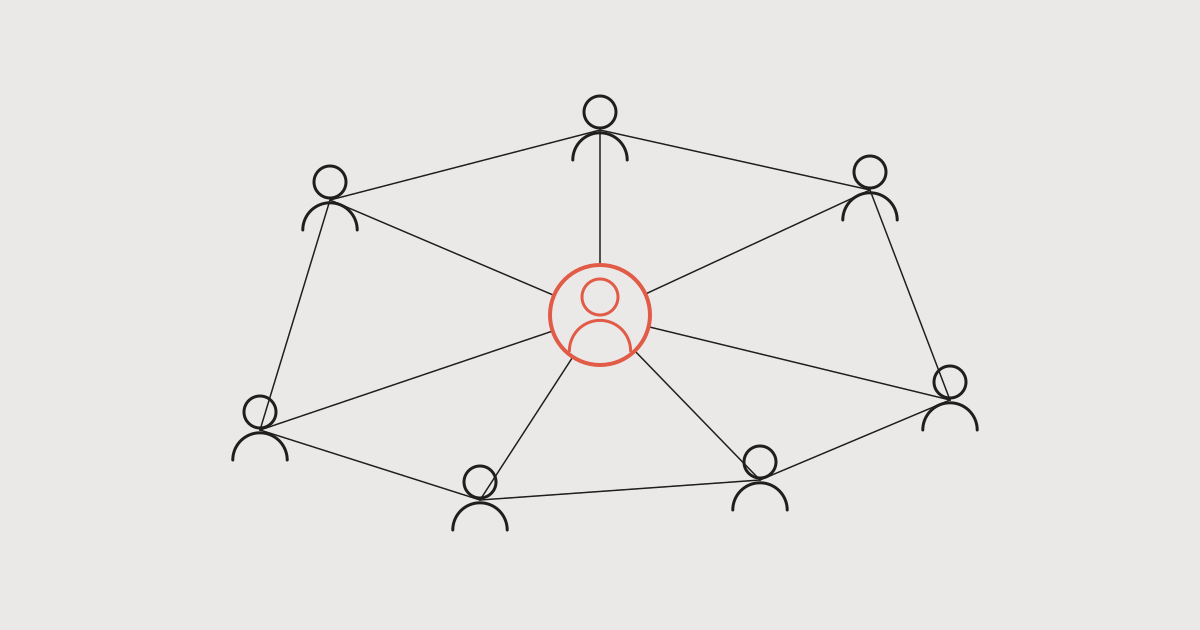
Start by making real connections
Through the years I have been collecting business cards from meetings or emails and adding those contacts as LinkedIn connections.
I don’t have 30,000 connections or thousands of followers like many members of the platform, such as the great Oleg Vishnepolsky, but I can say that I personally know most of my connections.
My connections and I have a history of collaboration outside LinkedIn, in the real world, in real projects.
I believe that is important because the link is stronger and we know each other in a variety of circumstances like meetings, phone talks, emails, documents, problems, difficulties, successes, and changes.
My advice is to build your network every day, with the people who are interacting with you now: your colleagues, your teammates, and your customers. Do it now; don’t wait until you have lost daily contact.
Be there for your contacts
Be proactive in congratulating your connections for their career moves and help promote their posts and business communications.
Use your network to create new connections. If you think that one of your connections can be useful to another, ask them, and if both agree, use LinkedIn messaging to introduce them.
My advice is to include LinkedIn in your daily routine: take a look once or twice a day and interact with your contacts.
Keep it professional
Remember that every social network has its purpose; LinkedIn is strictly professional. Don’t publish anything that is not related to your industry, your job or your business. Don’t even use it for birthday greetings because it is not the appropriate place!
Use LinkedIn professionally and be careful with what you share; it is not the best place to discuss religion, politics, sports, and parties if those topics are not your main business.
Review your public image
How do you use or present yourself in other social networks and on the Internet in general?
Take into consideration the following aspects:
- Do you have a proper profile picture on WhatsApp, Facebook, Instagram, and Twitter, even if it is for private use?
- Are there any embarrassing words in your public email address or social networks nicknames like lazy4everything?
- Search for your name on the Internet and see what the results for text and images are. Is that what you want to show publicly? (e.g., remember that old MySpace profile)
Ask yourself if your overall digital image is good for your job objectives.
Share
I am sure you have taken a lot of free information from the Internet, you use free and open source software developed by someone and read articles like this one for free. That is one of the best uses of the Internet.
Well, what about you? Are you contributing your opinions, your knowledge, or your time to society?
There are many ways to contribute. Make sure you start, and make it a habit, so that in a few years you have created a positive digital presence that inspires others.
Pay It Forward, start today by creating a public Git Lab / Hub repository to share and showcase your code, write articles at LinkedIn, create a Blog or website, start collaborating with a local NGO. Show the world what you can do, and do it for free!
Keep learning
There are endless opportunities to learn for very low prices or even free, make good use of your time and commit to learning something new every day.
Need ideas?
- Find a public speaking course in your community or join Toastmasters International
- Enroll in Coursera or edX and learn something new from the best universities in the world.
- Forgot a specific lesson on math, physics, chemistry, biology, history, art, or economics? Go to Khan Academy for a quick reminder.
- If you are into books, there are many great books under 10 USD that will teach you a lot.
Don’t have time?
- Read books or listen to podcasts while commuting or exercising.
- Spend less time on social networks or watching TV.
- Read articles from your industry. I use Feedly on my phone to keep track of many websites that publish articles about my industry.
Don’t have money for infrastructure?
- AWS (Amazon Web Services) offers a free tier. Take a look at my article “Using Terraform to create an AWS VPC with an EC2 Instance and a MariaDB RDS Database”
- Google Cloud Platform has a free tier as well.
- Microsoft Azure also offers a free account.
- If you are more into hardware, explore the ESP8266 microchip and the NodeMCU; with them you can build IoT Wi-Fi-enabled devices for less than 3 USD apiece.
Learning is a lifetime activity; current knowledge gets outdated faster every day. Keeping yourself updated is your responsibility, and it can be easy, fun, and free.
In the next articles, I will talk about how to build your LinkedIn profile and a paper resume.
Do you have any other daily habits that have proven to be useful for finding a new job?
Read the second part at Effective Job Search Using LinkedIn (II)