 Javier Ruiz Jiménez
How to transform into a SaaS company?
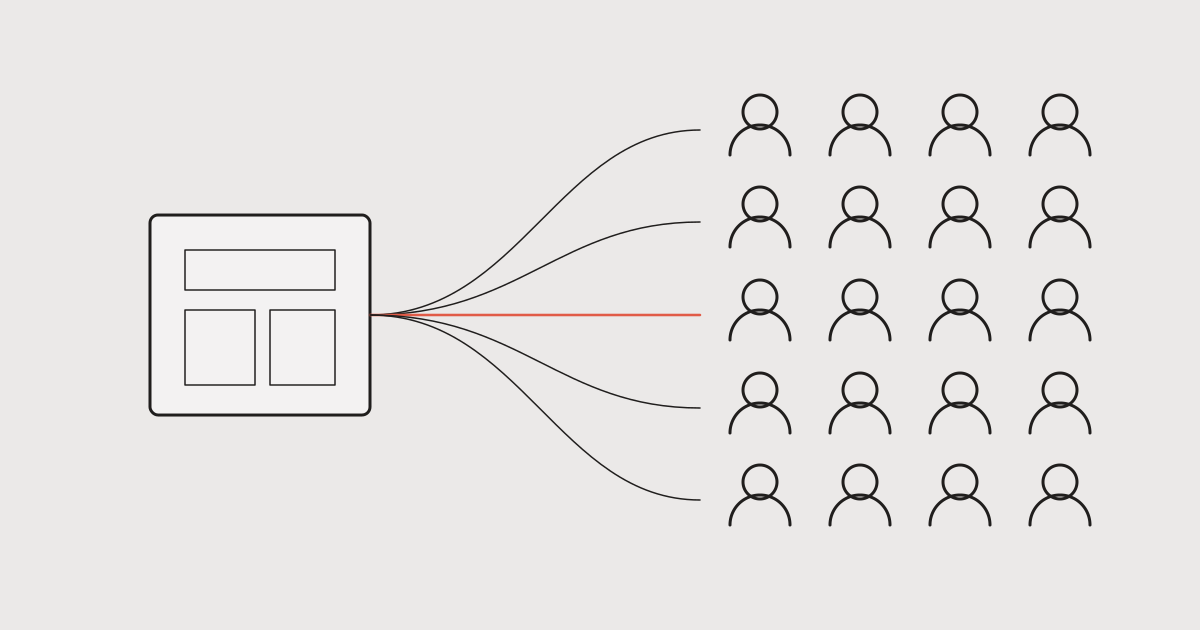
Are you a software company struggling to find happiness?
I used to develop software for other companies. Clients would define the requirements with help from our consultants, and our developers would write all the code needed to create custom software to solve the client’s needs. I wasn’t happy!
Some of the challenges we had with custom software development:
Intellectual property for software (ownership and rights)
When an ISV develops software for a client, the client usually owns the intellectual property and the source code. This means that the ISV’s developers and consultants who invest a lot of time and energy to understand the client’s business and needs and to create a customized software solution for them do not retain any rights over their work.
The client can then share the source code with another ISV for further development or maintenance. It is difficult for an ISV to secure exclusive rights with a client.
Creating software for others can be draining, and the benefits of that work are transferred to the paying company.
Big risk and low margins (competition and profitability)
Software development is a challenging and costly process, but many ISV clients are reluctant to pay a fair price. They may not appreciate the technical expertise and effort required to deliver a quality product and may choose the lowest bidder regardless of their credentials or track record.
ISVs face fierce competition from various types of companies, some of which are inexperienced but offer low rates, some of which outsource the work to cheaper locations, and some of which are large consulting firms that can afford to lose money to win the contract.
Small ISVs are forced to lower their prices and take on big risks if their estimates are inaccurate or their team faces difficulties, resulting in low or even negative profits.
Restricted choices
Big corporations have strict policies on how software has to be built and what platforms, servers, programming languages, and libraries can be used.
When an ISV develops software for big corporations, there are many restrictions imposed that limit or completely determine what to use. Unfortunately, these limitations are usually outdated, make innovation very hard, and are frustrating for developers to deal with.
Reliance on a few key staff (talent shortage)
Many ISVs depend on a few key developers and consultants who have the skills and experience necessary to lead a junior team and build quality software products.
When a new custom software development project is initiated, it can be difficult to form a new development team because it often involves reassigning people from another ongoing project, creating stress and increasing risk. Acquiring new clients or projects becomes a painful challenge.
Reliance on a few key staff is hard to overcome in the current market for engineering talent because there is a limited pool of new engineers, and those who are available need to be adequately trained in enterprise requirements, as there is a gap between what universities teach and what companies need.
Developers also have high maintenance costs, and the ISV needs to reserve funds to keep offering competitive salaries even when there is a shortage of new development projects.
Talent scarcity impacts all regions because remote work has enabled hiring from anywhere in the world.
Developer satisfaction and motivation (purpose, salary, and perks)
Great developers love working on meaningful projects that have a positive impact on society, and they enjoy a steady supply of fresh fruit, unlimited PTO (paid time off), a generous above-market salary, a cozy office where they can meet occasionally, and the latest hardware and best perks.
The truth is that most ISVs don’t have the luxury of choosing their clients’ projects, and offering the best employee experience is costly.
How can ISVs escape from this vicious cycle?
Not all ISVs face the above challenges; some have managed to build successful software factories in remote cities with very low competition for talent and have strong connections at the top levels that provide ample custom software development project opportunities.
If this is not your case, there is an option to completely transform your company and enjoy the benefits of taking control of your software and development projects.
Do you want to enjoy these rewards?
I transformed my ISV company into a SaaS provider and reaped the following rewards:
- Access to a large pool of new clients who could now afford our software.
- A fully automated and consistent infrastructure architecture to manage and specialize in.
- The freedom to choose the best hardware and software platforms for our applications.
- A high-quality customer support process that our clients appreciated.
- Peace of mind by having the proper disaster recovery procedures and distributed infrastructure.
- Comprehensive documentation of our products and procedures.
- Full responsibility for, and control of, system maintenance and proactive monitoring.
- Healthy margins and a business model that scales without having to keep adding staff.
- Extensive sector knowledge and creation of intellectual property.
- A blue ocean strategy that drew the attention of other companies that wanted to acquire us.